

Introduction
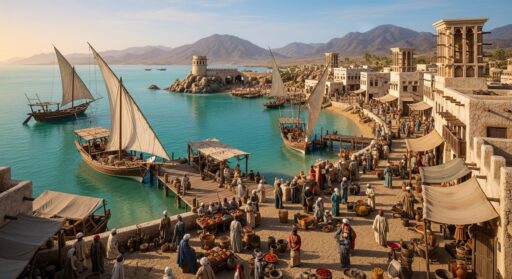
Long before the mega-ports of Jebel Ali and Khalifa, the coastline of the UAE was dotted with thriving trading hubs that connected the Arabian Peninsula to the world. Among the most significant was Julfar, a port city in what is now Ras Al Khaimah, whose history spans over a millennium. For centuries, Julfar was a legendary name on medieval Arab and European maps, a nexus of pearl, pottery, and slave trade, and the home of the formidable Al Qawasim seafarers. Its eventual abandonment and disappearance beneath the sands make it one of the most fascinating archaeological mysteries and a testament to the cyclical nature of maritime power.
The Golden Age: A Hub of Medieval Trade
From the 13th to the 16th centuries, Julfar flourished as one of the most important ports in the lower Gulf. Its prosperity was built on a triad of industries. First was the pearl trade, with its pearls being renowned from India to Venice. Second was its prolific pottery industry; the distinctive Julfar ware—unglazed cooking pots and storage jars—has been found at archaeological sites across the Indian Ocean, evidence of its extensive trade network. Third was its role in regional commerce, exporting dates, horses, and pearls and importing textiles, timber, and ceramics from Persia, India, and China.
The Home of the Al Qawasim
Julfar is intrinsically linked to the rise of the Al Qawasim tribe, who would become the ruling family of Ras Al Khaimah and Sharjah. The city served as their power base, from which they built a formidable fleet of trading and fighting vessels. The seafaring skills and naval prowess honed in Julfar allowed the Qawasim to dominate the maritime routes of the lower Gulf and the Strait of Hormuz. Their power was such that they came into direct conflict with the expanding Portuguese empire in the 16th and 17th centuries, who sought to control the same vital waterways.
The Portuguese Onslaught and Gradual Decline
Julfar’s strategic location made it a target. The Portuguese, seeking to control the spice trade, attacked and occupied the port in the 16th century, building a fort to assert their dominance. Although the Portuguese were eventually expelled, the disruption to trade took its toll. Furthermore, shifting sandbars and the silting up of the creek that provided access to the city likely began to hamper its function as a deep-water port. The final blow is believed to have been a combination of tribal warfare and the gradual shift of political and economic focus to other, more accessible locations along the coast.
The Rediscovery: Unearthing a Lost City
For centuries, the exact location of Julfar was lost, known only from historical texts. Its rediscovery in the 20th century was a triumph of archaeology. Excavations at sites like Al Nudud and Al Mataf revealed the extensive remains of the city: foundations of houses, a large fortress, and countless fragments of imported Chinese celadon and blue-and-white porcelain, as well as local Julfar ware. These findings confirmed the city’s wealth and its far-reaching connections, physically proving the stories told in old manuscripts and maps.
Conclusion: The Legacy of a Maritime Giant
Today, Julfar lies silent beneath the modern developments of Ras Al Khaimah, but its legacy is profound. It stands as a powerful reminder that the UAE’s current status as a global trading hub has deep historical roots. The story of Julfar is one of rise, resilience, and eventual decline—a cycle dictated by geography, politics, and the volatile nature of maritime commerce. It provides the essential historical context for the region’s seafaring tradition and the enduring mercantile spirit that would, centuries later, find new expression in the ports of the modern UAE.