

Introduction
While the western coast of the UAE faces the Arabian Gulf, the emirate of Sharjah boasts a vital window to another sea: the Gulf of Oman. This window is the natural deep-water port of Khor Fakkan, a city whose strategic location has made it a coveted trading post for empires and a key logistical hub for centuries. Shielded by the dramatic Hajar Mountains, Khor Fakkan’s story is one of geographic fortune, agricultural abundance, and its evolving role in the maritime strategy of the region, from the Age of Sail to the era of global container shipping.
A Natural Harbor and Agricultural Heartland
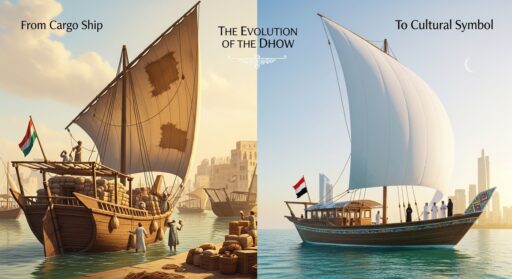
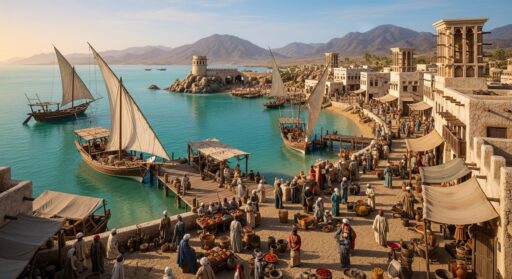
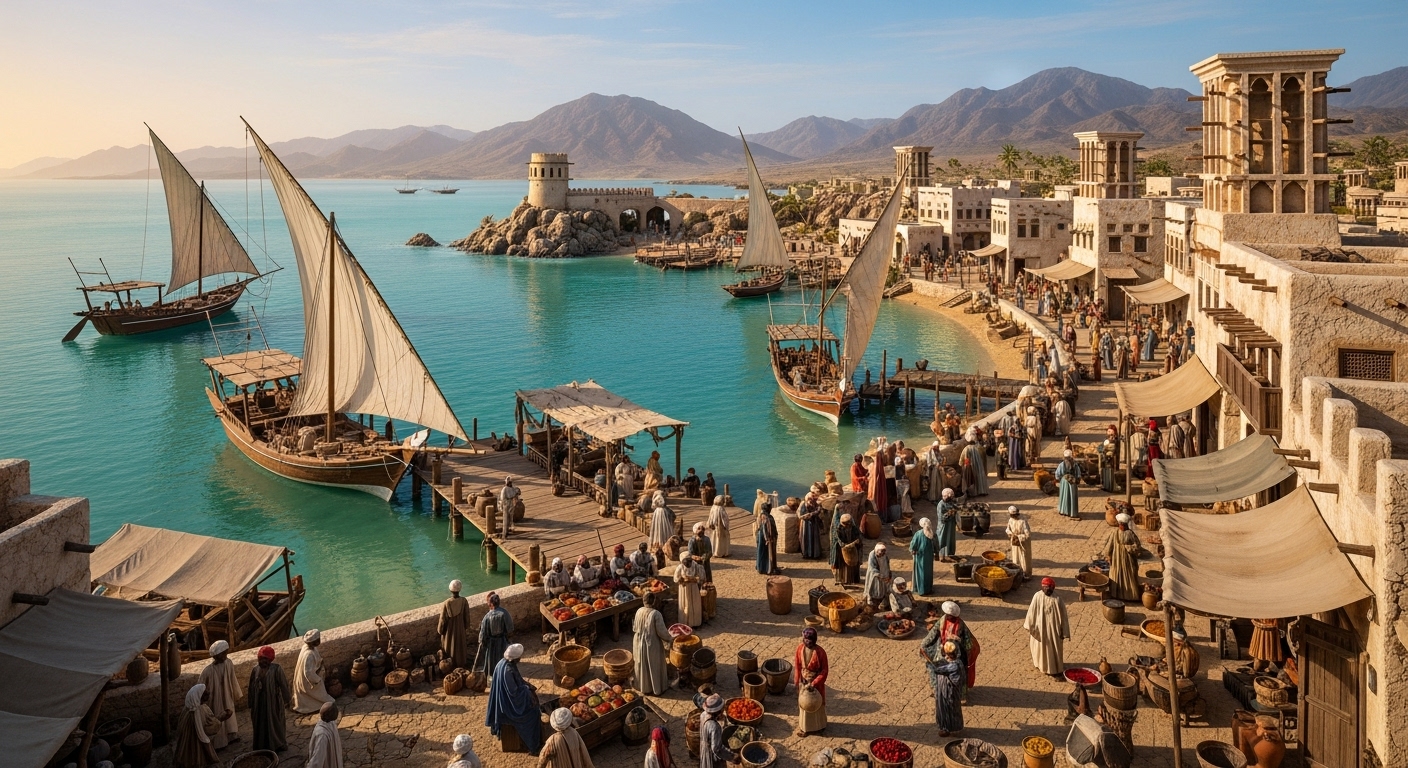
Khor Fakkan’s name means “Creek of Two Jaws,” describing its perfect, sickle-shaped bay which provides natural protection from storms. This made it an ideal haven for dhows traveling the monsoon routes between Mesopotamia, India, and East Africa. Unlike many other coastal settlements, Khor Fakkan was also blessed with a fertile plain, allowing for the cultivation of dates, citrus fruits, and other crops. This combination of a safe harbor and a self-sustaining agricultural hinterland made it a prosperous and strategically valuable location long before the modern era.
A Prize for Empires: Portuguese Forts and Omani Influence
Khor Fakkan’s strategic value did not go unnoticed by regional powers. In the 16th century, the Portuguese, seeking to control the trade routes to India, attacked and occupied the town, building a fort to assert their dominance (the ruins of which can still be seen). After the Portuguese were expelled, control of Khor Fakkan oscillated between the Al Qawasim of Sharjah and the Sultans of Oman, reflecting its position on a contested frontier. This history of foreign interest underscores its perennial importance as a gateway between the Arabian interior and the Indian Ocean.
The Modern Port: Sharjah’s Container Gateway
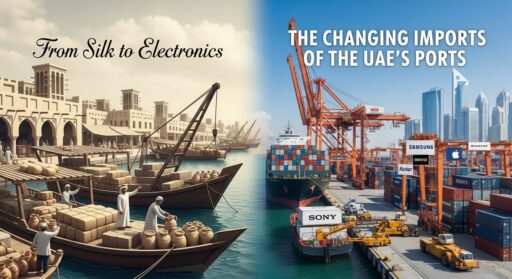
In the modern era, Khor Fakkan’s natural advantages were leveraged for the global economy. The Port of Khor Fakkan (POK) was developed into a major container terminal. Its location on the Gulf of Oman is a significant logistical advantage; it is outside the Strait of Hormuz, allowing ships to avoid the congestion of the Arabian Gulf and service the broader region more efficiently. POK has become one of the largest container ports in the world and the primary hub for feeder traffic in the lower Gulf, transferring containers from large mother ships onto smaller vessels that serve other regional ports like Dubai and Abu Dhabi.
A Hub for Tourism and Cruise Ships
In addition to its cargo role, Khor Fakkan has emerged as a major tourism destination for Sharjah. Its stunning scenery, with mountains plunging into the sea, has been developed with corniches, parks, and resorts. The port has also become a regular stop for international cruise liners, which disgorge thousands of passengers to explore its beaches and dramatic landscape. This dual identity—as a hard-edged logistical hub and a scenic tourist escape—encapsulates the modern economic diversification of the UAE.
Conclusion: The Eastern Anchor
Khor Fakkan’s story is one of enduring strategic relevance. From a haven for wooden dhows to a state-of-the-art container terminal and a thriving tourist destination, it has continuously adapted to the demands of the era. It serves as Sharjah’s vital eastern anchor, providing the emirate with direct access to global shipping lanes and a share of the lucrative maritime trade. Khor Fakkan demonstrates that in the UAE’s narrative of trade, geography remains destiny, and a good natural harbor, whether on the Arabian Gulf or the Gulf of Oman, is a treasure that never loses its value.